Ondo Air
Earbuds product page template · Shops and makers
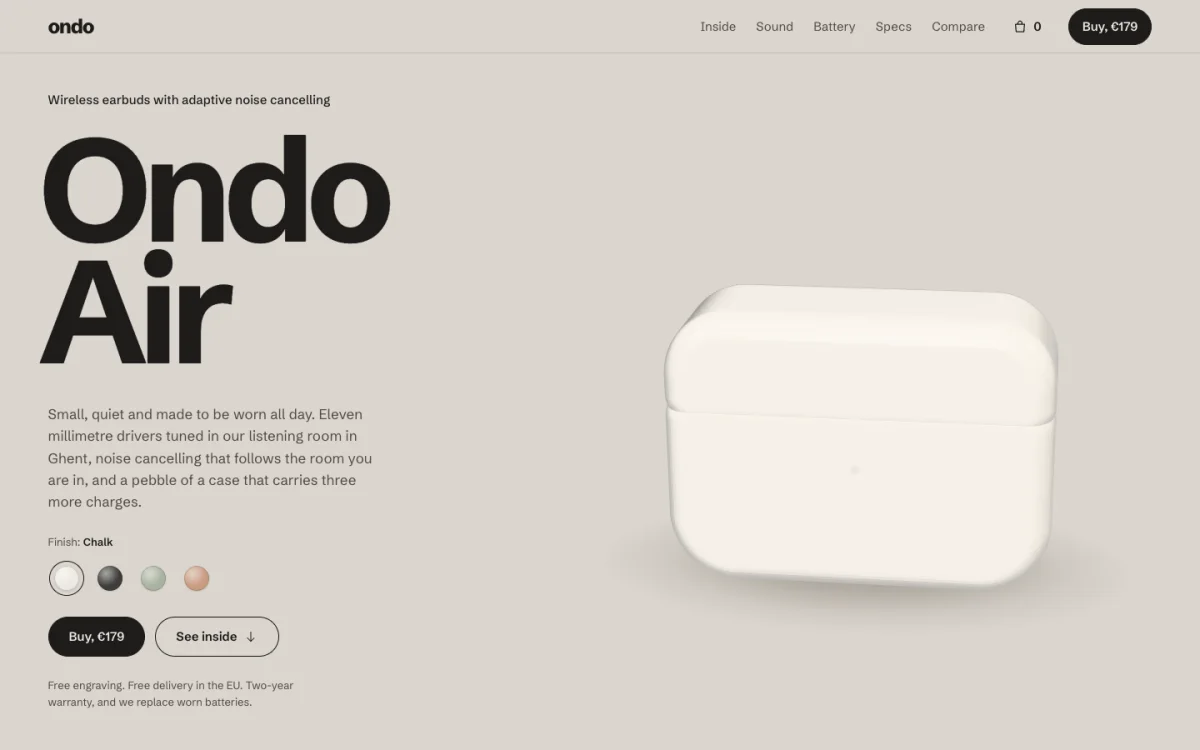
A quiet audio workshop's catalogue: one warm-grey ground, huge whitespace, the product name set enormous in Schibsted Grotesk, small precise captions, and a real-time 3D case and buds that open and come apart as you read.
The page opens on the product name set very large beside a live three.js model of the Ondo Air case. Everything in the model is built in code: the pebble case is two extruded rounded profiles that meet at a hairline seam, the buds are spheres, capsules and lathe-turned ear tips, all in a glossy clearcoat finish under a studio room environment with a soft contact shadow. Choose Chalk, Graphite, Sage or Clay and the case, buds and ear tips glide to the new finish. Drag to turn it, or use the turn buttons or the arrow keys.
The model stays put while three short steps scroll beside it. The lid swings open on its hinge, the buds lift out and turn, and one bud comes apart into its driver, microphone array and battery, each labelled with a caption projected from its point in 3D. Below, the noise cancelling demo draws the outside noise, the counter-signal and what reaches your ear for a tram, a café or an open office, with the decibel numbers to match. Battery life is drawn to scale and adds up, 7 hours in the buds plus three recharges from the case, and switches to the figures without noise cancelling.
Then the specifications, a comparison with the Ondo Mini and Ondo Studio, and a drawn plate of what comes in the box. The buy box takes a finish and an optional engraving with a live preview on the drawn case, a character count and specific errors, then shows loading, error with retry, or success with the bag total. A sold-out finish swaps the button for an email sign-up. Questions and the footer close the page. Without WebGL, with reduced motion or without JavaScript, a carefully drawn SVG of the open case and exploded bud takes the model's place in the same layout.
The brand is fictional: Ondo Audio, a small audio company with a workshop and listening room in Ghent, making three models of wireless earbuds. Names, people and figures on the page are invented.
What works
- 3D model: drag to turn (limited orbit, no zoom or pan), turn left, front view and turn right buttons, arrow keys and Home when the canvas is focused
- Finish swatches in the hero and the buy box: recolour the model with a 750ms tween, the drawing, the buy preview and the captions
- Scroll steps: the lid opens, the buds lift out, one bud explodes into driver, mic array and battery with projected callouts
- Noise cancelling switch and Tram, Café, Open office choice: animated waveforms and the dB(A) readout
- Battery: noise cancelling on or off redraws the to-scale bar and the sum (7 + 21 = 28 h, 9 + 27 = 36 h)
- Compare table scrolls sideways on phones with the row names pinned
- Engraving: live preview on the case, character count, max 14, specific errors for unsupported characters or spaces only
- Add to bag: loading, error with Try again, success with finish, engraving, delivery and bag total; header bag count
- Sold-out finish: struck swatch, email sign-up with validation and confirmation
- Questions accordion (native details)
States you can link to
script.js reads these from the URL, so you can open the page in a given state to review it, screenshot it or show it to an agent.
| Parameter | What it does |
|---|---|
?color=graphite | opens in Graphite (also chalk, sage, clay). Open ?color=graphite |
?view=exploded | scrolls to the last step so the case is open and the bud taken apart, with callouts. Open ?view=exploded |
?state=soldout | the chosen finish is sold out; the buy box shows the notify sign-up. Open ?state=soldout |
?state=error | adds an engraved pair to the bag and the shop does not answer; Try again succeeds. Open ?state=error |
?nogl | skips WebGL and shows the drawn SVG product with its callouts. Open ?nogl |
Use it
Copy templates/earbuds/ into your project, or download the zip, which has the Screenery badge script already removed. Colours, type, spacing and radii are custom properties at the top of style.css. This template loads no libraries: only its own files and web fonts.
The docs explain the token pattern and how to move a template into React, Vue, Svelte or Astro. The guide has prompts for handing it to a coding agent.
Inspection
Loaded in Chromium 156.0.8078.4 (Playwright, headless) on 27 November 2026 at 1440, 1024, 768, 390 pixels wide and once more with reduced motion requested. Every check passed at every width.
- 1440 px
- Pass
- 1024 px
- Pass
- 768 px
- Pass
- 390 px
- Pass
- Reduced motion
- Pass
- Page weight
- 365 KB, 9 requests
Requests and transferred size were measured at 1440 pixels on a cold cache and include web fonts and any CDN library. The full result is in the viewer: open the Checks panel. How templates are checked.