Gambit Club
Chess learning app template · App screens
A chess club room in the evening: walnut and maple, green baize, brass fittings and one warm lamp over a lathe-turned wooden set.
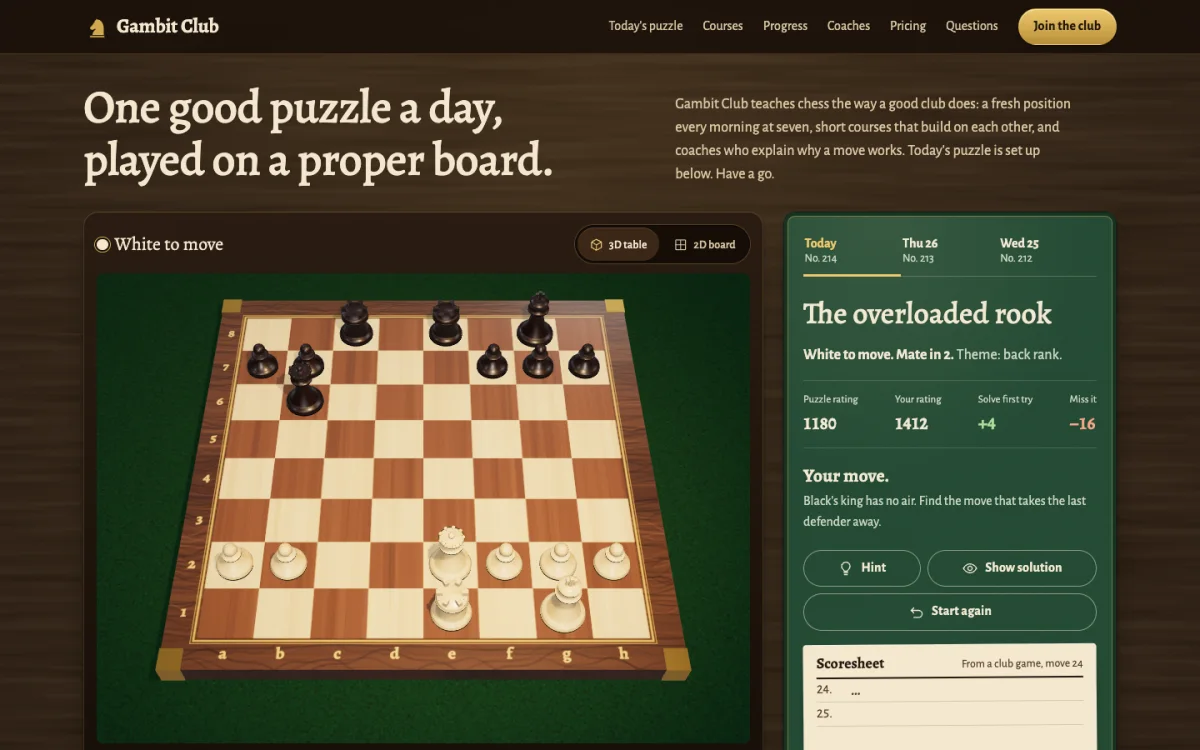
The first screen is the app itself: today's puzzle on a walnut and maple board under a lamp, rendered with three.js. Every piece is turned from a lathe profile, the knight's head is an extruded profile, the wood grain is painted into canvas textures and the pieces cast soft shadows onto the board. Beside it sits a baize panel with the puzzle, the rating it puts at stake, a feedback line, hints and a handwritten scoresheet.
The puzzles are really playable. A compact move generator knows every legal move, and a first move is accepted when it forces mate against every defence. Drag a piece, click it and then its square, or use the arrow keys and Enter. A wrong move bounces back with the refutation and a hint, a right one draws Black's forced reply, and mate opens the explanation. A 2D board of 64 labelled buttons plays the same game and takes over without WebGL or with reduced motion.
Below are courses with progress that always adds up, a streak calendar and a 30-day rating chart with the Elo sum worked out for the current puzzle, three coaches with bookable clinic seats, free and Club pricing with a billing toggle, a sign-up form with inline validation, loading, error and success, and the questions people ask.
The brand is fictional: Gambit Club, a fictional app that teaches chess through one daily puzzle, short courses and live clinics with three club coaches. Names, people and figures on the page are invented.
What works
- 3D board: drag or click to move, arrow keys and Enter on the canvas, wrong moves bounce back
- 2D board: 64 buttons labelled like "e4, white knight", roving focus, drag or click
- Three mate-in-two puzzles with legal move checking, refutations, two hints, show solution and start again
- Scoresheet in algebraic notation; rating, streak and chart update on a solve
- 3D table / 2D board toggle
- Course tabs with lessons that tick the totals up
- Rating chart readout on hover and with the arrow keys
- Book a clinic seat or join a waiting list
- Monthly and yearly pricing toggle feeding the sign-up plan
- Sign-up form: validation, loading, error, success and reset
- Questions accordion and a mobile menu that closes with Escape
States you can link to
script.js reads these from the URL, so you can open the page in a given state to review it, screenshot it or show it to an agent.
| Parameter | What it does |
|---|---|
?puzzle=2 | opens Thursday's puzzle, Boden's mate (?puzzle=3 opens the smothered mate). Open ?puzzle=2 |
?board=2d | starts on the 2D board (?board=3d forces the 3D table). Open ?board=2d |
?state=solved | plays the solution as a first-try solve: rating up, streak 23, explanation shown. Open ?state=solved |
?state=failed | plays the tempting wrong move: refutation, hint and the rating loss. Open ?state=failed |
?signup=success | fills and sends the sign-up form, showing the welcome. Open ?signup=success |
?signup=error | fills and sends the sign-up form, showing the server error. Open ?signup=error |
?nogl | switches WebGL off to show the 2D fallback. Open ?nogl |
Use it
Copy templates/chess/ into your project, or download the zip, which has the Screenery badge script already removed. Colours, type, spacing and radii are custom properties at the top of style.css. This template loads no libraries: only its own files and web fonts.
The docs explain the token pattern and how to move a template into React, Vue, Svelte or Astro. The guide has prompts for handing it to a coding agent.
Inspection
Loaded in Chromium 156.0.8078.4 (Playwright, headless) on 27 November 2026 at 1440, 1024, 768, 390 pixels wide and once more with reduced motion requested. Every check passed at every width.
- 1440 px
- Pass
- 1024 px
- Pass
- 768 px
- Pass
- 390 px
- Pass
- Reduced motion
- Pass
- Page weight
- 519 KB, 13 requests
Requests and transferred size were measured at 1440 pixels on a cold cache and include web fonts and any CDN library. The full result is in the viewer: open the Checks panel. How templates are checked.